
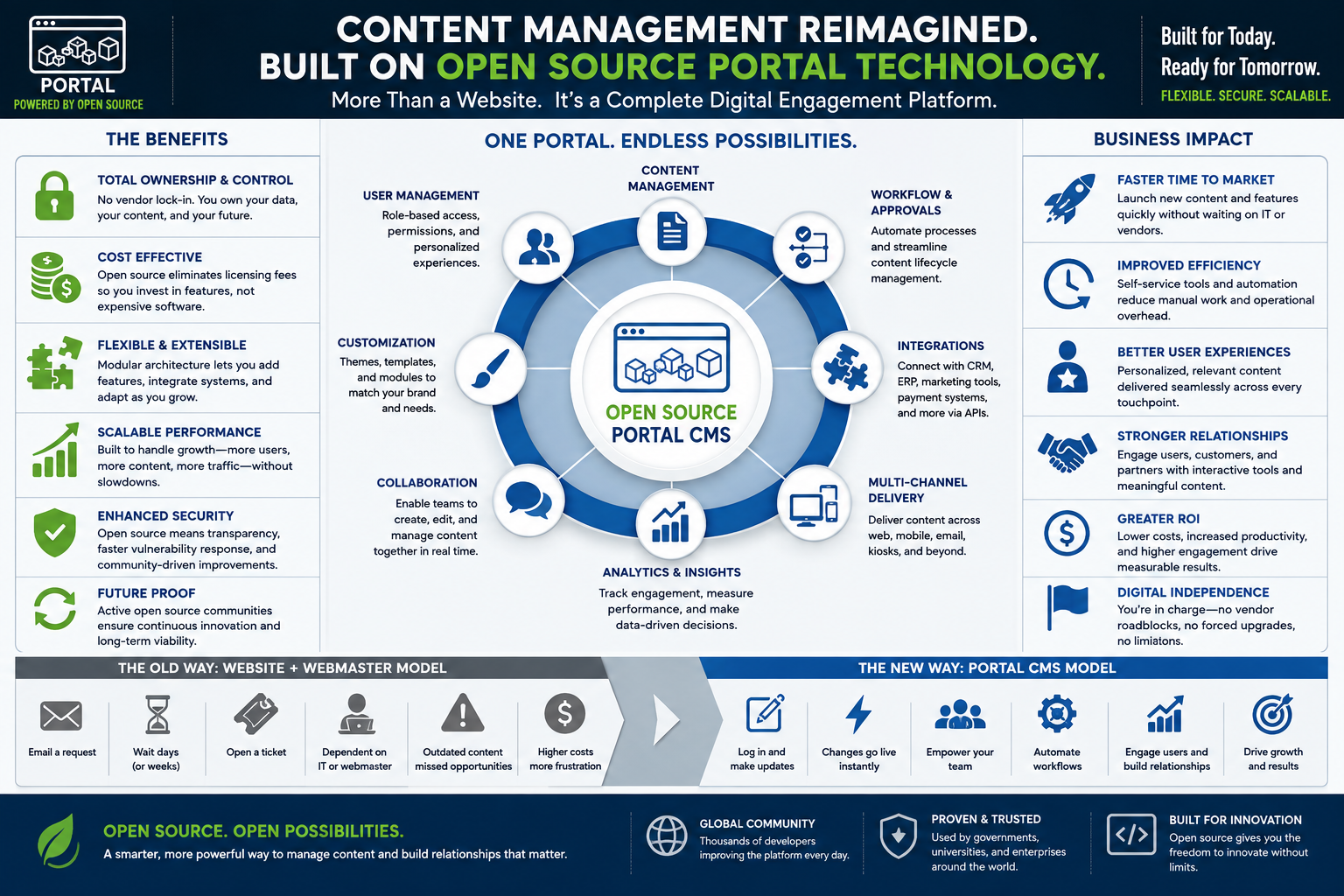
Why settle for a website when you can have a digital platform your organization can actually control?
For decades, businesses and organizations have accepted a frustrating model for managing their presence on the web: build a website, hire a webmaster, depend on developers, and call IT whenever something needs to change.
It seemed normal because that was the way the web evolved.
But it doesn’t have to be that way anymore.
A modern open source portal CMS changes the relationship between an organization and its technology. Instead of depending on a webmaster to make routine changes, a portal gives the organization the ability to manage content, users, workflows, integrations, and digital relationships directly.
The result is more than a better website.
It is a fundamentally different category of technology.
The Problem With the Traditional Website Model
Most websites were designed around a simple concept: publish information for people to read.
That worked when the web was primarily a digital brochure.
But organizations today need to do much more.
They need to:
- Update information immediately
- Manage customers, members, employees, and partners
- Create personalized experiences
- Connect business systems
- Automate workflows
- Collect and manage data
- Integrate third-party applications
- Provide secure access to different users
- Measure engagement
- Continuously improve the digital experience
Trying to accomplish all of this through a traditional website often creates a technology ecosystem that is increasingly complicated—and increasingly dependent on specialists.
A simple content change becomes an email.
An email becomes a request.
The request becomes a ticket.
The ticket goes to a webmaster, developer, agency, or IT department.
And suddenly, changing a sentence on a web page has become an IT project.
The Webmaster Became the Gatekeeper
The original promise of the web was freedom.
You could publish.
You could communicate.
You could reach customers directly.
Yet the traditional webmaster model often created the opposite experience.
You don’t update your website.
Your webmaster updates it for you.
You don’t control the technology.
Someone else does.
You don’t necessarily know where your data lives, how the system works, or what happens when the person who built it is no longer available.
This creates a dangerous form of digital dependency.
The problem isn’t necessarily the webmaster.
The problem is the architecture.
A system that requires a specialist for every routine change is not truly empowering the organization that owns it.
Enter the Portal
A portal represents a different approach.
A website is primarily designed to be visited.
A portal is designed to be used.
A website publishes information.
A portal manages interaction.
A website creates a digital presence.
A portal creates a digital relationship.
With an open source portal CMS, authorized users can manage their own digital environment through the portal itself.
Content can be created, edited, approved, published, organized, and updated without having to send every request to a webmaster.
That changes everything.
Instead of asking:
“Can you update the website?”
Your team can say:
“We updated the portal.”
What Is an Open Source Portal CMS?
An open source portal CMS combines content management capabilities with the broader functionality of a portal platform.
It can provide a centralized environment for managing:
- Content
- Users
- Permissions
- Documents
- Forms
- Workflows
- Applications
- Databases
- Integrations
- Analytics
- Communications
- Customer and member interactions
Because the underlying technology is open source, organizations can also avoid becoming completely dependent on a proprietary software vendor.
The source code is available.
The platform can be extended.
Integrations can be developed.
The system can evolve with the organization.
This is particularly important for organizations that want to own their technology rather than continually rent access to it.
Open Source Means More Than “Free”
One of the biggest misconceptions about open source is that its primary advantage is that the software doesn’t carry traditional licensing fees.
That’s certainly valuable.
But the bigger advantage is freedom.
Open source can provide greater freedom to:
- Customize the platform
- Extend functionality
- Integrate other systems
- Control data
- Select hosting environments
- Work with different technology providers
- Avoid proprietary lock-in
- Build for long-term requirements
The question isn’t simply:
“How much does the software cost?”
The better question is:
“How much control do we have over our technology?”
Put Your Organization Back in Control
A portal CMS is designed to put operational control closer to the people actually running the organization.
Marketing can manage content.
Sales can manage relevant information.
Customer service can manage resources.
Administrators can manage users and permissions.
Executives can access information and analytics.
Authorized employees can make changes without waiting for a developer.
This doesn’t mean technology specialists disappear.
It means their time can be spent where it creates more value.
Instead of spending hours changing text, fixing pages, installing plugins, and responding to routine website requests, technical teams can concentrate on architecture, cybersecurity, integrations, data governance, automation, and strategic technology initiatives.
Could a Portal Reduce Your IT Requirements?
For some organizations, the answer may be yes.
A well-designed portal can eliminate or dramatically reduce many of the routine technology requests that traditionally fall on IT departments.
Think about how much organizational time can disappear into questions such as:
- Can you update this page?
- Can you add this form?
- Can you change this image?
- Can you create another user?
- Can you publish this document?
- Can you change this workflow?
- Can you connect this application?
- Can you update this information?
When those capabilities are built into the portal, many of these requests become self-service operations.
The goal isn’t necessarily to “fire IT.”
The goal is to eliminate the need for IT to be involved in everything.
For smaller organizations, that could mean requiring fewer dedicated technical resources.
For larger organizations, it can mean dramatically reducing operational overhead and allowing IT professionals to focus on higher-value work.
A Portal Is a Relationship Platform
This may be the most important difference.
A website is often treated as a destination.
A portal is treated as an ongoing relationship.
Customers can return.
Members can log in.
Employees can collaborate.
Partners can access information.
Users can submit forms.
Organizations can automate responses.
Data can move between systems.
Interactions can be measured.
The portal becomes an environment where relationships can develop over time.
That is why a portal isn’t simply a better website.
It is a digital relationship infrastructure.
The Technical Advantages
A modern open source portal architecture can support capabilities such as:
Role-Based Access
Different users can receive different permissions and experiences.
Customers don’t need to see what employees see.
Partners don’t need access to internal information.
Administrators can control the system centrally.
Workflow Automation
Content and business processes can move through defined workflows.
Approvals, notifications, publishing, submissions, and other processes can be automated rather than managed manually.
API-Based Integration
A portal can serve as an integration layer connecting other business systems.
CRM.
ERP.
Payment systems.
Inventory.
Scheduling.
Customer databases.
Third-party applications.
The portal can become the place where these systems interact with people.
Scalability
The platform can grow as the organization grows.
More users.
More content.
More applications.
More relationships.
More transactions.
The architecture shouldn’t have to be rebuilt every time the organization evolves.
Analytics and Engagement
A portal can provide insight into how users interact with the organization.
What are they looking for?
What are they using?
Where are they engaging?
What processes are creating friction?
Data can turn the digital experience into something that can be measured and continuously improved.
From Website Maintenance to Portal Management
The old model is fundamentally reactive.
Something breaks.
Someone notices.
A ticket gets created.
Someone investigates.
A change is made.
The organization waits.
The portal model is fundamentally more proactive.
The organization identifies an opportunity.
An authorized user makes a change.
The change becomes part of the live digital environment.
The organization measures the result.
Then it improves again.
That’s not maintenance.
That’s digital operations.
Portal Consulting, Portal Hosting and Portal Maintenance
Creating a portal category also changes how technology services should be delivered.
Portal Consulting
Portal consulting isn’t simply about choosing a CMS.
It is about understanding how an organization operates and designing the digital architecture around its relationships, workflows, information, and users.
Portal Development
Portal development focuses on building functionality that solves real operational problems—not simply creating attractive web pages.
Portal Hosting
Portal hosting provides the infrastructure required to keep the digital platform secure, available, scalable, and performing reliably.
Portal Maintenance
Portal maintenance isn’t just fixing broken links or updating software.
It is the ongoing evolution of the organization’s digital platform.
The objective is continuous improvement.
From Dependency to Independence
The traditional website model often creates dependency:
Website → Webmaster → Developer → IT → Vendor
The portal model creates a different relationship:
Organization → Portal → Users → Relationships → Data → Growth
The difference is profound.
The technology becomes an organizational asset rather than a digital obstacle.
The Future Isn’t Another Website
The web has evolved.
Organizations have evolved.
Customers have evolved.
Technology has evolved.
The expectation that every organization should still depend on a webmaster to maintain a collection of static web pages belongs to an earlier era of the internet.
The next generation of digital platforms needs to be:
Open.
Flexible.
Connected.
Self-service.
Scalable.
Secure.
And most importantly, relationship-driven.
That’s what an open source portal CMS makes possible.
Welcome to the Portal Category
A portal isn’t just another name for a website.
It represents a different philosophy about how organizations should use technology.
Websites give people information.
Portals give people access.
Websites attract visitors.
Portals create participants.
Webmasters manage websites.
Organizations manage portals.
And when your organization can manage its own digital environment, technology stops being something you depend on—and starts becoming something you control.
